How to Read Minds of Others Story Mythology
One of the nigh enlightening "psychology" courses I took in college was not a psychology course at all, just, rather, a comparative literature grade on mythology in different cultures around the globe. I had e'er enjoyed reading myths every bit a child, so the grade looked like an interesting style to assistance fulfill a academy requirement in other cultures.
The course turned out to be both highly interesting and highly educational in unexpected ways, and I would like to share three things I learned from the form.
Universal Themes in Myths
1 of the most surprising revelations, documented in i of the books for the course, David Leeming's Mythology: Voyage of the Hero , was the degree of similarity across religious stories and myths from around the earth. Leeming shows how many myths follow an viii-stage pattern that reflects a heroic style of dealing with universal problems in the man lifespan, from the miracle of conception and birth through resurrection and ascension.

Source: Wikimedia Commons
What got me thinking well-nigh that mythology course was an Easter service I attended with my family terminal Sunday. The pastor'southward sermon naturally focused on the resurrection of Jesus, and emphasized how this was a unique story. Clearly, he had non read David Leeming (or Joseph Campbell, whose piece of work was the major source for Leeming's book). In the chapter on resurrection and rebirth, Jesus shares space with Heracles, Dionysos, Hyacinth, Adonis and Aphrodite, Telipinu, Amaterasu and Susanow, Buddha, Osiris and Isis, Hainuwele, the Corn Mother, Kutoyis, the Bear Human being, Attis, Wanjiru, Cuulu, and Quetzalcoatl.
What I plant specially uncanny was that even the fashion of Jesus'south decease was not unique, if we recognize the cross as a symbol for a tree. (Acts five:xxx reads "The God of our fathers raised Jesus, whom you killed by hanging him on a tree" and Acts 10:39 says "They put him to expiry past hanging him on a tree.") Attis, a Phrygo-Roman god who was said to be born of a virgin on December 25, was crucified on a tree and resurrected three days after on March 25th. The Egyptian god Osiris was murdered past his brother, Set. Osiris's wife and sister, Isis, placed the pieces into a tree and resurrected him. The Norse god Odin engaged in self-sacrifice past hanging himself from the groovy tree Yggdrasil and stabbing himself with a spear. This sacrifice was said to give him access to the powers and secrets of the runic alphabet.
It was my original intent to discuss the psychological significance of parallels across myths around the world, simply I eventually decided to spend more time on other lessons I learned in the mythology course. If you are interested in mythic parallels, I recommend to yous Leeming'south volume, now available in an edition that is newer than the ane I read in the 1970s.
Narrative Retentiveness and Your Life Story
I liked the construction of my mythology grade. Professor Kenneth Thigpen alternated betwixt talking about different approaches to understanding myths and actually narrating myths.
I of the first things I learned and was amazed by was how easy it was to call up the details of myths that I had never heard earlier. Usually a very thorough note-taker, I plant it barely necessary to take any notes at all as I sat, entranced by the instructor's stories from foreign and unfamiliar cultures. Come up test time, I found I had effortless, almost perfect recall of the details of these stories.
Many years afterwards the form was over, I would acquire why. Apparently, narratives (stories) represent a particular way of amalgam knowledge that comes naturally to us. One writer has even gone so far as saying "Remembering is narrative; narrative is retention."
Inquiry indicates that remembering a bunch of new, unrelated elements is difficult. Simply if the elements are role of a structured story, they are more easily remembered. That's just the fashion the mind works. Research also indicates that retention is not a literal replaying of experienced events, like replaying a recorded video. Rather, it is a reconstruction of significant elements in a style that makes sense to united states of america. Nosotros remember the by past making up stories in which the events relate to each other in a meaningful manner.
The fact that memory is reconstructive storytelling can crusade issues when we seek to know what actually happened, such as who-did-what during a traffic accident or a crime. Eyewitness testimony is not e'er reliable because when witnesses remember an incident at that place is a natural tendency to miss details that do not seem to fit the overall pattern of events or to add together data if information technology makes the story more coherent and sensible. Research has indicated that when therapists try to "recover" forgotten memories they can actually implant false memories if the memories help the client make sense of his or her life.

Source: Wikimedia Commons
On the other hand, nosotros tin can use the reconstructive nature of memory to our own advantage when we are troubled by events in our past. Research has demonstrated that writing almost stressful events in our lives can aid relieve the stress and improve both psychological and concrete wellness. Although simply expressing feelings through writing may have some benefits, writing appears to be almost helpful when we tin can frame troublesome events in a manner that makes them a meaningful part of an overall coherent life story.
Sam Not bad, quondam professor of philosophy and religion before becoming a contributing editor of Psychology Today, has written extensively on the power of authoring our own stories in books such as Your Mythic Journey: Finding Meaning in Your Life Through Writing and Storytelling and Hymns to an Unknown God: Awakening The Spirit In Everyday Life . Bang-up points to the similarity betwixt the words "author" and "say-so." Past authoring our life stories in a way that is meaningful to us, we have charge of our lives and achieve a more satisfying life.
In a previous Psychology Today post on the writings of don Miguel Ruiz, I described a number of his ideas that have solid support from mod psychology. I idea I did not mention was his suggestion that we are all artists who are constantly narrating our ain life stories.
In an interview called How to Change the Globe, Ruiz suggests that we cannot alter the globe past trying to alter the "secondary characters of your story" (i.east., other people). Instead, we can alter the world by irresolute "the chief grapheme of your story" (yourself), specifically by irresolute "the message that you deliver to yourself." This principle is a mainstay of cerebral-behavioral therapy: alter your self-talk, and this will change your feelings and your relationships.
Mythology and Truth
One last surprising lesson I learned in my mythology course concerned the relation betwixt myth and truth. In everyday voice communication, when nosotros say "that is a myth," we hateful "that is not truthful." Myth and truth are often seen as opposites. But in our mythology course, we learned a more complicated conception of myth.
A mythic story is not a simple suggestion that tin be judged as either true or false or even a string of true-or-false propositions. Rather, a mythic story attempts to brand sense of our perceptions and feelings within our feel of the globe in a narrative format. Certainly, many aspects of myths are not literally truthful. The Greek gods did not really live on Mt. Olympus and meddle in the diplomacy of human being beings. Nonetheless, myths refer to very real human experiences, otherwise they would make no sense. We understand the stories near the Greek gods considering they share some of our emotions and ambitions. The stories of Icarus and Phaethon resonate with us considering we accept seen or experienced within ourselves youthful tendencies to try to fly too high, only to crash and burn.
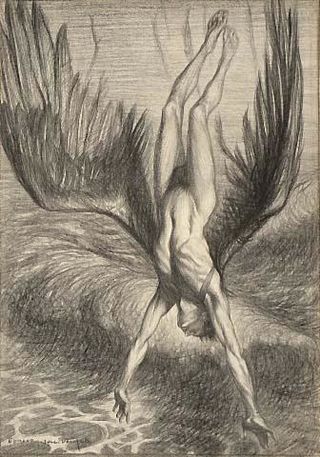
Source: Wikimedia Commons
A myth is neither completely true nor completely false. A skillful myth is one that artfully represents human experience. Yet no myth tin can completely represent all of human experience considering homo feel is so multidimensional and varied. At all-time, a myth captures some of import aspects of the domain of human being experience information technology is meant to represent. Just like a map, which captures simply of import features of the terrain, not every detail of the terrain it represents.
I began this blog post by calling my mythology class one of the most enlightening "psychology" courses I e'er took. My comparative literature form gave me three credits in the humanities, not the sciences or even social sciences. Because psychology purports to be a science, some readers might wonder whether talking about mythology in a Psychology Today post is even advisable. In my view, that depends on what we call back defines science as a method for agreement the world.
My conception of science has changed over the years, partly considering of my feel in my mythology grade. I used to think that science was a way of establishing with certainty facts about the world, what is absolutely truthful beyond whatsoever doubt. As I read more than about science and began to do science myself, I came to realize that in scientific discipline nosotros oftentimes endeavor to model reality rather than establish indubitable facts. Scientific noesis claims are e'er tentative and field of study to revision. We strive for ameliorate models of reality, not just by looking for more than facts, but past improving our insight and vision. A good scientific model is non one that attempts to capture every factual detail well-nigh reality but is able to identify fundamental variables that allow some accuracy in making predictions virtually the world. But like a expert myth provides enough insight nearly the world to aid usa navigate life's journeying.
solomontuptionvill.blogspot.com
Source: https://www.psychologytoday.com/us/blog/cui-bono/201704/what-mythology-reveals-about-the-mind
0 Response to "How to Read Minds of Others Story Mythology"
Post a Comment