what words would infantry use to call for help

Soldiers of the ROK Armed Forces sixth Infantry Partition, Reconnaissance Battalion, conducting exercise, 2014
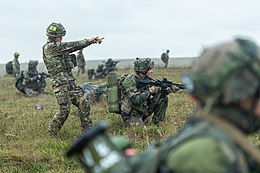
Infantry is an regular army specialization whose personnel engage in military combat, usually against other enemy ground forces, as function of ground forces. They operate weapons and equipment to engage and destroy enemy basis forces. Infantry generally consists of light infantry, mountain infantry, motorized infantry, marine infantry, mechanized infantry and airborne infantry. It is considered to be one of the nearly physically demanding and psychologically stressful war machine jobs.[one]
Infantry have much greater local situational awareness than other war machine forces, due to their inherent intimate contact with the battlefield ("boots on the ground");[2] this is vital for engaging and infiltrating enemy positions, holding and defending ground (whatsoever military objectives), securing battlefield victories, maintaining war machine area control and security both at and behind the front lines, for capturing ordnance or materiel, taking prisoners, and military machine occupation.[three] [4] Infantry can more hands recognise, conform and answer to local conditions, atmospheric condition, and changing enemy weapons or tactics. They can operate in a wide range of terrain inaccessible to military vehicles, and tin can operate with a lower logistical burden. Infantry are the nearly hands delivered forces to ground combat areas, past simple and reliable marching, or by trucks, bounding main or air transport; they can likewise be inserted straight into combat by amphibious landing, by air driblet with parachute (airborne infantry) or via air assault by helicopters (airmobile infantry). They can be augmented with a diverseness of crew-served weapons, armoured personnel carriers, and infantry fighting vehicles.
Etymology and terminology [edit]
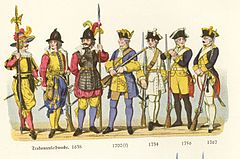

In English language, use of the term infantry began almost the 1570s, describing soldiers who march and fight on foot. The word derives from Middle French infanterie, from older Italian (besides Spanish) infanteria (foot soldiers too inexperienced for cavalry), from Latin īnfāns (without speech, newborn, foolish), from which English besides gets infant.[5] The private-soldier term infantryman was not coined until 1837.[vi] In mod usage, foot soldiers of whatsoever era are now considered infantry and infantrymen.[7]
From the mid-18th century until 1881 the British Army named its infantry every bit numbered regiments "of Pes" to distinguish them from cavalry and dragoon regiments (see List of Regiments of Foot).
Infantry equipped with special weapons were often named subsequently that weapon, such as grenadiers for their grenades, or fusiliers for their fusils.[annotation one] These names can persist long later the weapon speciality; examples of infantry units that retained such names are the Royal Irish Fusiliers and the Grenadier Guards.
More commonly in modern times, infantry with special tactics are named for their roles, such as commandos, rangers, snipers, marines, (who all have boosted grooming) and militia (who have limited preparation); they are nonetheless infantry due to their expectation to fight as infantry when they enter combat.
Dragoons were created every bit mounted infantry, with horses for travel between battles; they were still considered infantry since they dismounted before combat. However, if light cavalry was defective in an ground forces, any available dragoons might be assigned their duties; this practice increased over time, and dragoons eventually received all the weapons and training as both infantry and cavalry, and could be classified as both. Conversely, starting about the mid-19th century, regular cavalry have been forced to spend more of their time dismounted in combat due to the ever-increasing effectiveness of enemy infantry firearms. Thus well-nigh cavalry transitioned to mounted infantry. As with grenadiers, the dragoon and cavalry designations can be retained long after their horses, such as in the Purple Dragoon Guards, Royal Lancers, and King's Royal Hussars.
Similarly, motorised infantry have trucks and other unarmed vehicles for non-combat movement, just are however infantry since they leave their vehicles for any gainsay. Nigh mod infantry have vehicle ship, to the point where infantry being motorised is generally causeless, and the few exceptions might be identified equally modern light infantry, or "leg infantry" colloquially. Mechanised infantry get beyond motorised, having send vehicles with combat abilities, armoured personnel carriers (APCs), providing at least some options for combat without leaving their vehicles. In modern infantry, some APCs accept evolved to be infantry fighting vehicles (IFVs), which are ship vehicles with more than substantial gainsay abilities, approaching those of light tanks. Some well-equipped mechanised infantry can exist designated as armoured infantry. Given that infantry forces typically also have some tanks, and given that most armoured forces take more mechanised infantry units than tank units in their organisation, the distinction betwixt mechanised infantry and armour forces has blurred.
The terms infantry, armour, and cavalry used in the official names for armed services units like divisions, brigades, or regiments might exist better understood as a description of their expected residuum of defensive, offensive, and mobility roles, rather than just utilize of vehicles. Some mod mechanised infantry units are termed cavalry or armoured cavalry, even though they never had horses, to emphasise their gainsay mobility.
In the modern U.s. Army, well-nigh xv% of soldiers are officially Infantry.[8] The basic grooming for all new United states Regular army soldiers includes bones use of infantry used weapons and basic tactics, fifty-fifty for tank crews, artillery crews, and base of operations and logistical personnel.
History [edit]
The first military machine forces in history were infantry. In antiquity, infantry were armed with early on melee weapons such as a spear, axe, or sword, or an early ranged weapon like a javelin, sling, or bow, with a few infantrymen existence expected to apply both a melee and a ranged weapon. With the development of gunpowder, infantry began converting to primarily firearms. Past the time of Napoleonic warfare, infantry, cavalry and arms formed a basic triad of ground forces, though infantry ordinarily remained the most numerous. With armoured warfare, armoured fighting vehicles take replaced the horses of cavalry, and airpower has added a new dimension to footing combat, but infantry remains pivotal to all modern combined arms operations.

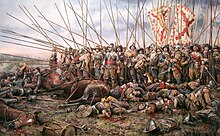

French infantry line performing a bayonet charge in 1913
The first warriors, adopting hunting weapons or improvised melee weapons,[ix] earlier the existence of any organised military, likely started substantially every bit loose groups without any organisation or formation. Just this changed sometime before recorded history; the first ancient empires (2500–1500 BC) are shown to take some soldiers with standardised military equipment, and the training and subject required for battlefield formations and manoeuvres: regular infantry.[x] Though the primary force of the ground forces, these forces were normally kept modest due to their price of training and upkeep, and might be supplemented by local brusk-term mass-conscript forces using the older irregular infantry weapons and tactics; this remained a common practice about up to mod times.[11]
Before the adoption of the chariot to create the outset mobile fighting forces c. 2000 BC,[12] all armies were pure infantry. Even subsequently, with a few exceptions similar the Mongol Empire, infantry has been the largest component of most armies in history.
In the Western world, from Classical Antiquity through the Middle Ages (c. 8th century BC to 15th century AD), infantry are categorised as either heavy infantry or light infantry. Heavy infantry, such as Greek hoplites, Macedonian phalangites, and Roman legionaries, specialised in dense, solid formations driving into the main enemy lines, using weight of numbers to achieve a decisive victory, and were usually equipped with heavier weapons and armour to fit their role. Low-cal infantry, such as Greek peltasts, Balearic slingers, and Roman velites, using open up formations and greater manoeuvrability, took on almost other combat roles: scouting, screening the army on the march, skirmishing to delay, disrupt, or weaken the enemy to prepare for the principal forces' battleground attack, protecting them from flanking manoeuvers, and then afterwards either pursuing the fleeing enemy or roofing their army's retreat.
After the fall of Rome, the quality of heavy infantry declined, and warfare was dominated by heavy cavalry,[xiii] such as knights, forming minor elite units for decisive stupor gainsay, supported by peasant infantry militias and contrasted light infantry from the lower classes. Towards the end of Middle Ages, this began to change, where more than professional person and meliorate trained light infantry could be effective against knights, such as the English longbowmen in the Hundred Years' War. By the kickoff of the Renaissance, the infantry began to return to potency, with Swiss pikemen and German Landsknechts filling the role of heavy infantry again, using dense formations of pikes to bulldoze off any cavalry.[14]
Dense formations are vulnerable to ranged weapons. Technological developments immune the raising of large numbers of light infantry units armed with ranged weapons, without the years of training expected for traditional high-skilled archers and slingers. This started slowly, first with crossbowmen, and so hand cannoneers and arquebusiers, each with increasing effectiveness, marking the starting time of early on modern warfare, when firearms rendered the utilize of heavy infantry obsolete. The introduction of musketeers using bayonets in the mid 17th century began replacement of the thruway with the infantry square replacing the pike square.[fifteen]
To maximise their firepower, musketeer infantry were trained to fight in wide lines facing the enemy, creating line infantry. These fulfilled the central battlefield role of earlier heavy infantry, using ranged weapons instead of melee weapons. To support these lines, smaller infantry formations using dispersed skirmish lines were created, chosen light infantry, fulfilling the aforementioned multiple roles as earlier low-cal infantry. Their arms were no lighter than line infantry; they were distinguished by their skirmish formation and flexible tactics.
The modern rifleman infantry became the primary force for taking and property ground on battlefields worldwide, a vital element of combined arms combat. As firepower continued to increase, utilise of infantry lines diminished, until all infantry became calorie-free infantry in practice.
Modernistic classifications of infantry have expanded to reverberate modern equipment and tactics, such as motorised infantry, mechanised or armoured infantry, mountain infantry, marine infantry, and airborne infantry.
Equipment [edit]
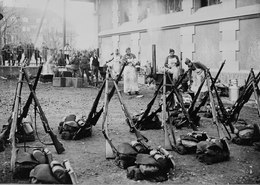
Swiss infantry kits arrayed in front of a field kitchen in Spitalacker, Bern during a workers' strike, c. 1918

US Army infantryman c. 1973
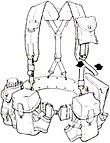
An infantryman's equipment is of vital business organization both for the man and the military. The needs of the infantryman to maintain fitness and effectiveness must be constantly balanced against existence overburdened. While soldiers in other war machine branches tin use their mountain or vehicle for carrying equipment, and tend to operate together as crews serving their vehicle or ordnance, infantrymen must operate more independently; each infantryman unremarkably having much more personal equipment to apply and carry. This encourages searching for ingenious combinations of effective, rugged, serviceable and adjustable, withal light, compact, and handy infantry equipment.
Across their main arms and armour, each infantryman'south "military kit" includes combat boots, battledress or combat compatible, camping gear, heavy atmospheric condition gear, survival gear, secondary weapons and ammunition, weapon service and repair kits, health and hygiene items, mess kit, rations, filled h2o canteen, and all other consumables each infantryman needs for the expected duration of time operating abroad from their unit's base, plus any special mission-specific equipment. 1 of the most valuable pieces of gear is the entrenching tool—basically a folding spade—which can be employed non simply to dig of import defences, but also in a variety of other daily tasks, and even sometimes every bit a weapon.[sixteen] Infantry typically accept shared equipment on top of this, like tents or heavy weapons, where the carrying burden is spread across several infantrymen. In all, this can achieve 25–45 kg (sixty–100 lb) for each soldier on the march.[17] Such heavy infantry burdens have changed piddling over centuries of warfare; in the late Roman Republic, legionaries were nicknamed Marius' mules as their main activity seemed to be carrying the weight of their legion around on their backs.[note 2] [18]
When combat is expected, infantry typically switch to "packing lite", pregnant reducing their equipment to weapons, ammo, and blank essentials, and leaving the rest with their send or luggage railroad train, at camp or rally indicate, in temporary hidden caches, or fifty-fifty (in emergencies) discarding whatever may deadening them down.[19] Boosted specialised equipment may be required, depending on the mission or to the particular terrain or environment, including satchel charges, sabotage tools, mines, barbed wire, carried by the infantry or attached specialists.
Historically, infantry have suffered high prey rates from disease, exposure, exhaustion and privation — often in backlog of the casualties suffered from enemy attacks.[20] Amend infantry equipment to support their wellness, energy, and protect from environmental factors greatly reduces these rates of loss, and increment their level of effective action. Health, free energy, and morale are greatly influenced by how the soldier is fed, and so militaries oft standardised field rations, starting from hardtack, to US Chiliad-rations, to modern MREs.
Communications gear has get a necessity, equally it allows effective command of infantry units over greater distances, and communication with artillery and other support units. Modernistic infantry can have GPS, encrypted individual communications equipment, surveillance and night vision equipment, advanced intelligence and other loftier-tech mission-unique aids.
Armies have sought to meliorate and standardise infantry gear to reduce fatigue for extended carrying, increase freedom of movement, accessibility, and compatibility with other carried gear, such equally the Us All-purpose Lightweight Individual Carrying Equipment (ALICE).
Weapons [edit]

Russian weapons from the 13th to 17th centuries
Infantrymen are defined by their primary arms – the personal weapons and body armour for their ain individual use. The available technology, resources, history, and society can produce quite different weapons for each military and era, just common infantry weapons tin can exist distinguished in a few basic categories.[21] [22]
- Ranged combat weapons: javelins, slings, blowguns, bows, crossbows, hand cannons, arquebuses, muskets, grenades, flamethrowers.[22]
- Close combat weapons: bludgeoning weapons similar clubs, flails and maces; bladed weapons like swords, daggers, and axes; pole weapons like spears, halberds, naginata, and pikes.[22]
- Both ranged and shut weapons: the bayonet fixed to a firearm allows infantrymen to employ the same weapon for both ranged combat and close gainsay. This started with muskets and connected with rifles to automatic firearms.[22] Use of the bayonet has declined with mod automatic firearms, but even so generally kept as a weapon of last resort.[23]
Infantrymen ofttimes acquit secondary or back-up weapons, sometimes called a sidearm or ancillary weapons in modern terminology, either issued officially as an addition to the soldier'south standard arms, or acquired unofficially past any other means as an private preference. Such weapons are used when the main weapon is no longer constructive, such it condign damaged, running out of armament, malfunction, or in a change of tactical situation where some other weapon is preferred, such as going from ranged to close gainsay. Infantry with ranged or pole weapons frequently carried a sword or dagger for possible mitt-to-manus combat.[21] The pilum was a javelin the Roman legionaries threw just before cartoon their principal weapon, the gladius (brusque sword), and endmost with the enemy line.[24]
Mod infantrymen now treat the bayonet every bit a backup weapon, only may as well have handguns or pistols. They may likewise deploy anti-personnel mines, booby traps, incendiary or explosive devices defensively before combat.
Some non-weapon equipment are designed for close combat shock effects, to proceeds a psychological edge before melee, such as battle flags, war drums, brilliant uniforms, vehement trunk paint or tattoos, and fifty-fifty battle cries. These have go mostly only formalism since the decline of close combat military tactics.
Protection [edit]

Infantry take employed many different methods of protection from enemy attacks, including various kinds of armour and other gear, and tactical procedures.
The almost basic is personal armour. This includes shields, helmets and many types of armour – padded linen, leather, lamellar, mail, plate, and kevlar. Initially, armour was used to defend both from ranged and close combat; even a fairly light shield could help defend against about slings and javelins, though loftier-forcefulness bows and crossbows might penetrate common armour at very close range. Infantry armour had to compromise betwixt protection and coverage, as a full suit of assail-proof armour would be besides heavy to clothing in combat.
As firearms improved, armour for ranged defence had to be thicker and stronger. With the introduction of the heavy arquebus designed to pierce standard steel armour, information technology was proven easier to make heavier firearms than heavier armour; armour transitioned to be merely for close combat purposes. Pikemen armour tended to be simply steel helmets and breastplates, and gunners petty or no armour. By the time of the musket, the dominance of firepower shifted militaries away from any close gainsay, and use of armour decreased, until infantry typically went without whatever armour.
Helmets were added back during World State of war I as artillery began to dominate the battleground, to protect against their fragmentation and other blast effects beyond a direct hit. Modern developments in bullet-proof composite materials like kevlar accept started a return to body armour for infantry, though the extra weight is a notable brunt.
In modernistic times, infantrymen must too oftentimes bear protective measures confronting chemic and biological attack, including military gas masks, counter-agents, and protective suits. All of these protective measures add to the weight an infantryman must carry, and may decrease combat efficiency. Mod militaries are struggling to rest the value of personal torso protection versus the weight burden and power to office under such weight.
Infantry-served weapons [edit]
Early crew-served weapons were siege weapons, like the ballista, trebuchet, and battering ram. Modernistic versions include machine guns, anti-tank missiles, and infantry mortars.
Formations [edit]
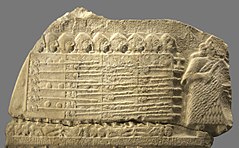
Beginning with the development the first regular armed services forces, close-combat regular infantry fought less as unorganised groups of individuals and more in coordinated units, maintaining a divers tactical formation during combat, for increased battlefield effectiveness; such infantry formations and the arms they used developed together, starting with the spear and the shield.
A spear has decent attack abilities with the boosted advantage keeping opponents at distance; this advantage tin can be increased by using longer spears, but this could allow the opponent to side-step the point of the spear and shut for hand-to-hand combat where the longer spear is near useless. This can exist avoided when each spearman stays next with the others in close formation, each covering the ones next to him, presenting a solid wall of spears to the enemy that they cannot get effectually.
Similarly, a shield has decent defence force abilities, merely is literally hit-or-miss; an assail from an unexpected angle can bypass information technology completely. Larger shields can embrace more than, but are also heavier and less manoeuvrable, making unexpected attacks fifty-fifty more of a problem. This can exist avoided by having shield-armed soldiers stand up close together, side-by-side, each protecting both themselves and their firsthand comrades, presenting a solid shield wall to the enemy.

The opponents for these beginning formations, the close-combat infantry of more than tribal societies, or any military machine without regular infantry (so called "barbarians") used artillery that focused on the individual – weapons using personal strength and forcefulness, such every bit larger swinging swords, axes, and clubs. These take more than room and individual freedom to swing and wield, necessitating a more loose system. While this may allow for a vehement running attack (an initial shock advantage) the tighter germination of the heavy spear and shield infantry gave them a local manpower advantage where several might be able to fight each opponent.
Thus tight formations heightened advantages of heavy artillery, and gave greater local numbers in melee. To likewise increase their staying power, multiple rows of heavy infantrymen were added. This also increased their daze combat issue; individual opponents saw themselves literally lined-up against several heavy infantryman each, with seemingly no chance of defeating all of them. Heavy infantry developed into huge solid block formations, up to a hundred meters wide and a dozen rows deep.
Maintaining the advantages of heavy infantry meant maintaining formation; this became even more important when two forces with heavy infantry met in boxing; the solidity of the formation became the deciding factor. Intense field of study and training became paramount. Empires formed effectually their military.
Organization [edit]
The system of military forces into regular military machine units is first noted in Egyptian records of the Boxing of Kadesh (c. 1274 BC). Soldiers were grouped into units of fifty, which were in plow grouped into larger units of 250, then ane,000, and finally into units of up to v,000 – the largest independent command. Several of these Egyptian "divisions" fabricated upward an army, but operated independently, both on the march and tactically, demonstrating sufficient military command and control organisation for basic battlefield manoeuvres. Similar hierarchical organizations have been noted in other ancient armies, typically with approximately ten to 100 to i,000 ratios (even where base ten was not common), like to modern sections (squads), companies, and regiments.[25]
Training [edit]

The training of the infantry has differed drastically over time and from place to place. The cost of maintaining an army in fighting order and the seasonal nature of warfare precluded large permanent armies.
The antiquity saw everything from the well-trained and motivated citizen armies of Greek and Rome, the tribal host assembled from farmers and hunters with just passing associate with warfare and masses of lightly armed and ill-trained militia put up equally a concluding ditch effort. Kushite king Taharqa enjoyed military success in the Near East as a result of his efforts to strengthen the regular army through daily grooming in long altitude running.[26]
In medieval times the foot soldiers varied from peasant levies to semi-permanent companies of mercenaries, foremost amongst them the Swiss, English, Aragonese and German, to men-at-arms who went into battle equally well-armoured as knights, the latter of which at times also fought on foot.
The cosmos of standing armies—permanently assembled for war or defence—saw increase in training and feel. The increased use of firearms and the need for drill to handle them efficiently.
The introduction of national and mass armies saw an establishment of minimum requirements and the introduction of special troops (first of them the engineers going back to medieval times, but also unlike kinds of infantry adopted to specific terrain, bicycle, motorcycle, motorised and mechanised troops) culminating with the introduction of highly trained special forces during the get-go and 2d World War.
Operations [edit]

Attack operations [edit]
Set on operations are the most basic function of the infantry, and along with defense force, form the master stances of the infantry on the battlefield. Traditionally, in an open up battle, or meeting appointment, two armies would manoeuvre to contact, at which point they would form upwards their infantry and other units reverse each other. Then 1 or both would advance and effort to defeat the enemy strength. The goal of an attack remains the same: to advance into an enemy-held objective, most frequently a hill, river crossing, metropolis or other dominant terrain feature, and dislodge the enemy, thereby establishing control of the objective.
Attacks are often feared past the infantry conducting them because of the high number of casualties suffered while advancing to close with and destroy the enemy while under enemy burn down. In mechanised infantry the armoured personnel carrier (APC) is considered the assaulting position. These APCs can deliver infantrymen through the front lines to the battle and—in the case of infantry fighting vehicles—contribute supporting firepower to engage the enemy. Successful attacks rely on sufficient force, preparative reconnaissance and battlefield preparation with flop assets. Memory of discipline and cohesion throughout the attack is paramount to success. A subcategory of attacks is the ambush, where infantrymen lie in wait for enemy forces before attacking at a vulnerable moment. This gives the ambushing infantrymen the combat reward of surprise, concealment and superior firing positions, and causes confusion. The ambushed unit does not know what information technology is upward against, or where they are attacking from.
Patrol operations [edit]

Indonesian Regular army Infantry soldiers from the 642nd Infantry Battalion line upwards before deployment to the international Border of Indonesia and Papua New Guinea in 2013 for edge patrol operations in dumbo forests and mountainous terrain
Patrolling is the virtually mutual infantry mission. Full-scale attacks and defensive efforts are occasional, but patrols are constant. Patrols consist of small groups of infantry moving nigh in areas of possible enemy activity to locate the enemy and destroy them when constitute. Patrols are used not just on the front end-lines, but in rear areas where enemy infiltration or insurgencies are possible.
Pursuit operations [edit]
Pursuit is a role that the infantry often assumes. The objective of pursuit operations is the destruction of withdrawing enemy forces which are not capable of effectively engaging friendly units, before they tin build their strength to the point where they are effective. Infantry traditionally have been the main strength to overrun these units in the by, and in modern gainsay are used to pursue enemy forces in constricted terrain (urban areas in particular), where faster forces, such as armoured vehicles are incapable of going or would exist exposed to ambush.
Defence operations [edit]
Defence operations are the natural counter to attacks, in which the mission is to hold an objective and defeat enemy forces attempting to dislodge the defender. Defensive posture offers many advantages to the infantry, including the ability to use terrain and constructed fortifications to advantage; these reduce exposure to enemy fire compared with advancing forces. Effective defence relies on minimising losses to enemy fire, breaking the enemy'south cohesion before their accelerate is completed, and preventing enemy penetration of defensive positions.
Escort operations [edit]
Escorting consists of protecting support units from deadfall, particularly from hostile infantry forces. Combat support units (a majority of the military) are not likewise armed or trained equally infantry units and have a different mission. Therefore, they need the protection of the infantry, specially when on the move. This is i of the about important roles for the modernistic infantry, particularly when operating alongside armoured vehicles. In this capacity, infantry essentially conducts patrol on the move, scouring terrain which may hide enemy infantry waiting to ambush friendly vehicles, and identifying enemy potent points for set on by the heavier units.

Base defense force [edit]
Infantry units are tasked to protect certain areas like control posts or airbases. Units assigned to this job usually have a large number of military police fastened to them for control of checkpoints and prisons.
Manoeuvring operations [edit]
Maneouvering consumes much of an infantry unit'due south time. Infantry, like all combat arms units, are often manoeuvred to meet battleground needs, and often must do and so under enemy attack. The infantry must maintain their cohesion and readiness during the motility to ensure their usefulness when they attain their objective. Traditionally, infantry have relied on their own legs for mobility, merely mechanised or armoured infantry often uses trucks and armoured vehicles for transport. These units tin speedily disembark and transition to light infantry, without vehicles, to access terrain which armoured vehicles can't finer access.
Reconnaissance/intelligence gathering [edit]
Surveillance operations are often carried out with the employment of pocket-size recon units or sniper teams which gather information near the enemy, reporting on characteristics such equally size, activity, location, unit and equipment. These infantry units typically are known for their stealth and ability to operate for periods of time within close proximity of the enemy without being detected. They may appoint high-profile targets, or be employed to hunt downward terrorist cells and insurgents within a given area. These units may also entice the enemy to appoint a located recon unit of measurement, thus disclosing their location to be destroyed by more than powerful friendly forces.
Armed services reserve forcefulness [edit]
Some assignments for infantry units involve deployment behind the front, although patrol and security operations are usually maintained in case of enemy infiltration. This is usually the all-time time for infantry units to integrate replacements into units and to maintain equipment. Additionally, soldiers can be rested and general readiness should improve. However, the unit of measurement must be fix for deployment at any signal.
Structure/engineering [edit]
This tin be undertaken either in reserve or on the front, only consists of using infantry troops as labor for construction of field positions, roads, bridges, airfields, and all other manner of structures. The infantry is oftentimes given this assignment because of the concrete quantity of potent men within the unit of measurement, although it can lessen a unit's morale and limit the unit'due south power to maintain readiness and perform other missions. More than often, such jobs are given to specialist engineering corps.
Raids/hostage rescue [edit]
Infantry units are trained to quickly mobilise, infiltrate, enter and neutralise threat forces when appropriate combat intelligence indicates to secure a location, rescue or capture loftier-profile targets.
Urban combat [edit]
Urban combat poses unique challenges to the combat forces. It is ane of the about complicated type of operations an infantry unit volition undertake. With many places for the enemy to hide and ambush from, infantry units must exist trained in how to enter a city, and systematically clear the buildings, which most probable volition exist booby trapped, in order to kill or capture enemy personnel within the city. Care must be taken to differentiate innocent civilians who often hibernate and support the enemy from the non-uniformed armed enemy forces. Noncombatant and military casualties both are usually very high.[27]
Day to day service [edit]

Because of an infantryman'due south duties with firearms, explosives, concrete and emotional stress, and physical violence, casualties and deaths are not uncommon in both war and in peacetime grooming or operations. Information technology is a highly dangerous and demanding combat service; in Globe State of war Two, military doctors concluded that the boilerplate American soldier fighting in Italy was psychologically worn out after nearly 200 days of combat.[28]
The concrete, mental, and ecology operating demands of the infantryman are high. All of the combat necessities such as ammunition, weapon systems, food, water, vesture, and shelter are carried on the backs of the infantrymen, at least in light role as opposed to mounted/mechanised. Combat loads of over 36 kg (eighty lbs) are standard, and greater loads in excess of 45 kg (100 lbs) are very common.[29] [30] These heavy loads, combined with long pes patrols of over forty km (25 mi) a day, in whatsoever climate from 43 to −29 °C (109 to −20 °F) in temperature, crave the infantryman to be in good concrete and mental condition. Infantrymen live, fight and die outdoors in all types of vicious climates, often with no physical shelter. Poor climate conditions adds misery to this already demanding beingness. Disease epidemics, frostbite, heat stroke, trench pes, insect and wild creature bites are common along with stress disorders and these accept sometimes caused more than casualties than enemy activeness.[xxx]
Some infantry units are considered Special Forces. The earliest Special Forces commando units were more highly trained infantrymen, with special weapons, equipment, and missions. Special Forces units recruit heavily from regular infantry units to fill their ranks.[31]
[edit]
| NATO Map Symbol |
|---|
  |
| Naval Infantry Company |
 |
| Air Force Infantry Company |
Naval infantry, commonly known as marines, are primarily a category of infantry that grade function of the naval forces of states and perform roles on state and at sea, including amphibious operations, as well as other, naval roles. They also perform other tasks, including land warfare, carve up from naval operations.
Air force infantry and base defense force forces, such equally the Purple Air Force Regiment, Royal Australian Air Forcefulness Airfield Defence force Guards, and Indonesian Air Force Paskhas Corps are used primarily for ground-based defense of air bases and other air force facilities. They also have a number of other, specialist roles. These include, among others, Chemic, Biological, Radiological and Nuclear (CBRN) defence and training other airmen in bones ground defense tactics.
See likewise [edit]
- Air assault
- Armoured infantry
- Combined artillery
- Foot guards
- Fusiliers
- Glider infantry / Paratrooper
- Grenadiers
- Indonesian Ground forces infantry battalions
- Infantry Branch (United States)
- Infantry of the British Army
- Infantry tactics
- Line infantry
- Marines
- Mechanized infantry
- Medium infantry
- Marine (military)
- Motorised infantry
- Mountain troops
- Mounted infantry
- U.s.a. Army Rangers
- Riflemen
- Royal Canadian Infantry Corps
- School of Infantry
- Special forces
- Pathfinder (military)
Notes [edit]
- ^ A fusil was early flintlock firearm that was safer to use effectually the gunpowder stores of cannons than matchlocks.
- ^ Marius' reforms of the Roman regular army included making each human responsible for carrying his ain supplies, weapons and several days' worth of ration. This made the legions less dependent on the baggage train and therefore more mobile.
References [edit]
Citations [edit]
- ^ In Praise of Infantry, by Field Marshal Archibald Wavell, 1st Earl Wavell, The Times, Thursday, xix April 1945
- ^ Strater, Laura D. (2001). Assay of Infantry Situation Sensation Training Requirements. U.S. Army Research Plant for the Behavioral and Social Sciences.
- ^ p. xiii, Nafziger
- ^ p. 257, Tobin
- ^ "Infantry". Online Etymology Dictionary . Retrieved 17 October 2017.
- ^ "Infantryman". Online Etymology Lexicon . Retrieved 17 October 2017.
- ^ "Infantry". Dictionary.com . Retrieved 17 October 2017.
- ^ Molinaro, Kristin (fifteen September 2010). "Infantry leaders sharpen training tactics to run across battlefield demands". The Bayonet. United states of america Army. Retrieved 28 October 2017.
- ^ Kelly, Raymond (October 2005). "The evolution of lethal intergroup violence". PNAS. 102 (43): 24–29. doi:10.1073/pnas.0505955102. PMC1266108. PMID 16129826.
- ^ Keeley, War Before Civilisation, 1996, Oxford Academy Press, pg.45, Fig. 3.one
- ^ Newman, Simon (29 May 2012). "Military in the Middle Ages". thefinertimes.com . Retrieved half dozen October 2015.
- ^ Wilford, John Noble (22 February 1994). "Remaking the Wheel: Evolution of the Chariot". The NY Times, Scientific discipline. The NY Times. Retrieved 12 Nov 2017.
- ^ Kagay, Donald J.; Villalon, Fifty. J. Andrew (1999). The Circle of War in the Middle Ages. Boydell Press. p. 53. ISBN9780851156453.
- ^ Carey, Brian Todd (2006). Warfare in the Medieval World. London: Pen & Sword Armed forces. p. chapter 6. ISBN9781848847415.
- ^ Archer, Christon I. (1 January 2002). Earth History of Warfare . U of Nebraska Press. p. 291. ISBN978-0803219410.
- ^ "Armed services kit through the ages: from the Boxing of Hastings to Helmand". The Telegraph. Archived from the original on iv August 2014. Retrieved 26 Oct 2017.
- ^ White potato, Patricia. "Weight Of War: Soldiers' Heavy Gear Packs On Hurting". NPR.org . Retrieved 26 October 2017.
- ^ "Marius Reforms the Legions". UNRV History . Retrieved 26 October 2017.
- ^ Handy, Aaron, Jr. (2010). "Part Two, chapter 3". That Powerless Feeling. Trafford Publishing. ISBN978-1-4251-3155-5.
- ^ McPherson, James 1000. (1989). Battle weep of liberty : the Civil War era (1st Ballantine books ed.). Ballantine Books. p. 485. ISBN0345359429.
- ^ a b Zabecki, David T. (28 Oct 2014). Germany at War: 400 Years of Military History. ABC-CLIO. p. 640. ISBN978-1598849806.
- ^ a b c d Blumberg, Naomi. "List of weapons". Encyclopedia Britannica. The Encyclopædia Britannica, Inc. Retrieved 13 November 2017.
- ^ Kontis, George. "Are We Forever Stuck with the Bayonet?". Pocket-sized Arms Defence Periodical . Retrieved 13 Nov 2017.
- ^ Zhmodikov, Alexander (2000). "Roman Republican Heavy Infantrymen in Battle (IV-Ii Centuries B.C.)". Historia: Zeitschrift für Alte Geschichte. Vol. 49. ABC-CLIO. p. 640. ISBN978-1598849806.
- ^ Centeno, Miguel A.; Enriquez, Elaine (31 March 2016). "Origins of Battle". State of war and Society. John Wiley & Sons. pp. 81–84. ISBN978-0-313-22348-eight.
- ^ Török, László (1998). The Kingdom of Kush: Handbook of the Napatan-Meroitic Civilization. Leiden: Brill. pp. 132–133, 153–184. ISBN90-04-10448-8.
- ^ The Us Army'south Preparedness to Conduct Urban Gainsay: A Strategic Priority, pp. 2–3
- ^ Pfau, Ann Elizabeth (2008). "i: Fighting for Domicile". Miss Yourlovin: GIs, Gender, and Domesticity during World War Two. Columbia University Press. ISBN978-0231135528.
- ^ "Infantry: The Weight Won't Become Abroad". strategypage.com . Retrieved 27 December 2015.
- ^ a b "U.S. Army Medical Section Center & Schoolhouse Portal" (PDF). army.mil. Archived from the original (PDF) on 26 August 2012. Retrieved 27 December 2015.
- ^ Singh, Upender (8 February 2022). Battalion Control Dare to Atomic number 82. gaurav book center.
Sources [edit]
- English language, John A., Gudmundsson, Bruce I., On Infantry, (Revised edition), The Military Profession series, Praeger Publishers, London, 1994. ISBN 0-275-94972-9.
- The Times, Earl Wavell, Thursday, 19 April 1945 In Praise of Infantry.
- Tobin, James, Ernie Pyle'south State of war: America's Eyewitness to Globe War II, Free Press, 1997.
- Mauldin, Beak, Ambrose, Stephen Eastward., Up Front end, W. W. Norton, 2000.
- Trogdon, Robert W., Ernest Hemingway: A Literary Reference, Da Capo Printing, 2002.
- The New York Times, Maj Gen C T Shortis, British Director of Infantry, iv February 1985.
- Heinl, Robert Debs, Lexicon of Military and Naval Quotations, Plautus in The Braggart Captain (third century AD), Naval Plant Printing, Annapolis, 1978.
- Nafziger, George, Napoleon's Invasion of Russia, Presidio Press, 1998.
- McManus, John C. Grunts: inside the American infantry combat feel, Earth War II through Iraq New York, NY: NAL Caliber. 2010 ISBN 978-0-451-22790-4 plus Webcast Author Lecture at the Pritzker Armed forces Library on 29 September 2010.
External links [edit]
 | Wikimedia Commons has media related to Infantry. |
- Historic films and photos showing Infantries in World War I at europeanfilmgateway.eu
- In Praise of Infantry, by Field-Marshal Earl Wavell; First published in "The Times," Th, 19 April 1945.
- The Lagunari "Serenissima" Regiment KFOR: KFOR Chronicle.
- Web Version of U.S. Army Field Manual three-21.8 – The Infantry Rifle Platoon and Squad.
- . Encyclopædia Britannica. Vol. fourteen (11th ed.). 1911. pp. 517–533. — includes several drawings
solomontuptionvill.blogspot.com
Source: https://en.wikipedia.org/wiki/Infantry
0 Response to "what words would infantry use to call for help"
Post a Comment